
Currently, the Corporate Income Tax Law stipulates that dividends are income in cash or other assets derived from:
- shares; or
- other rights, not arising from debt obligations, to participate in the distribution of profits of a commercial company or a cooperative society.
Any other income is not considered dividends. It is precisely this relatively simple definition of dividends that can currently create situations where the same income is taxed twice.
Accordingly, amendments to the Corporate Income Tax Law have been developed, which provide for the expansion of the definition of the term “dividends” to also include:
- the liquidation quota; and
- the portion of remuneration from a share buyback attributable to profit distribution.
In this article, we will examine why such changes are necessary and what they will mean in practical terms.
Share Buybacks
Let us consider the following situation.
A commercial company registered in Latvia, LatCo (hereinafter – PARENT), owns 1,000 shares, or 100%, in a commercial company registered in Lithuania, LitCo (hereinafter – SUBSIDIARY). The value of one SUBSIDIARY share is 10 euros.
The SUBSIDIARY wishes to buy back 100 of its own shares from the PARENT, constituting 10% of all shares, in order to grant them to board members and employees.
The PARENT sells 100 of its SUBSIDIARY shares to the SUBSIDIARY for 2,000 euros—namely, at a price exceeding their nominal value (100 × 10 = 1,000 euros).
Accordingly, the income portion in the amount of 1,000 euros (2,000 – 1,000) constitutes the PARENT’S profit, which will subsequently be distributed to its shareholders as dividends.
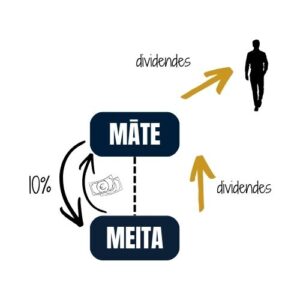
The SUBSIDIARY, being a commercial company registered in Lithuania, is a corporate income tax payer in Lithuania. Accordingly, the SUBSIDIARY has already paid corporate income tax on the profit, including the 2,000 euros used for the buyback of its own shares from the PARENT.
Thus, a situation arises where the tax on the income used for the share buyback has already been paid for the first time at the SUBSIDIARY level. Conversely, the tax will be paid a second time at the PARENT level when distributing this profit as dividends to its shareholders.
In other countries, the portion of remuneration from a share buyback attributable to profit distribution is considered a dividend payment. In Latvia, however, such income is currently not considered dividends. Consequently, the tax exemptions provided for in Section 6 of the Corporate Income Tax Law cannot be applied to it.
Section 6 of the Corporate Income Tax Law provides for the taxpayer’s right to reduce the amount of dividends included in the CIT taxable base during the taxation period to the extent that the taxpayer has received dividends during the taxation period from a dividend payer who is a CIT payer in their country of residence, or dividends from which tax has been withheld in the country of payment.
For example, if the PARENT receives dividends in the amount of 10,000 euros from the SUBSIDIARY in Lithuania, in accordance with Section 6 of the CIT Law, the PARENT, as a Latvian commercial company, is entitled to reduce the CIT taxable base by the received dividends in the amount of 10,000 euros.
However, the current definition of dividends does not allow for the reduction of the CIT taxable base by the portion of remuneration from a share buyback attributable to profit distribution, which in the considered example is 1,000 euros. Accordingly, when the PARENT distributes this profit as dividends, it will be required to pay CIT on the said remuneration, even though CIT on this income has already been paid at the SUBSIDIARY level.
Liquidation Quota
Similar considerations apply to the liquidation quota.
Tax has also already been paid on income distributed as a liquidation quota at the level of the liquidated SUBSIDIARY. Thus, the question arises as to why tax should be payable repeatedly on this same income at the level of the income recipient, namely the PARENT.
What Exactly Will Change?
To prevent the situations described above and to avoid the double taxation of the same income, the draft law provides for the expansion of the definition of the term “dividends.”
Henceforth, it is intended that dividends shall include not only income from shares and other rights to participate in the profit distribution of a commercial company or cooperative society, but also:
- the liquidation quota; and
- the portion of remuneration from a share buyback attributable to profit distribution.
Thus, upon receiving any of the aforementioned income, which will henceforth be considered dividends, the taxpayer will be entitled to apply the exemption stipulated in Section 6 of the CIT Law as described above.
Furthermore, the draft law provides that only that part of the liquidation quota which constitutes a positive difference between the equity value of the liquidated taxpayer and the amount invested by the shareholder shall be included in the CIT taxable base.
Conversely, if dividends include income from a share buyback, the portion of remuneration that constitutes a positive difference between the calculated remuneration for the shares and the nominal value of the shares shall be included in the CIT taxable base.
In addition, the transitional provisions of the CIT Law stipulate that the liquidation quota and remuneration for the acquisition of one’s own shares shall be considered dividends starting from January 1, 2026.
Accordingly, taxpayers will be entitled to perform CIT adjustments, including the submission of amended CIT declarations, for the period starting January 1, 2026.
